Sima Yan
The Romance of the Three KingdomsSima Yan is the Sima family’s successor to the Wei throne and the founder of the Great Jin dynasty. His accession completes a cycle of dynastic transfers: after the Han gives way to Wei, he takes the throne from Wei and later reunites the Three Kingdoms under Jin.
Succession and the Jin Kingship
In summer AD 264, Sima Yan’s father, Sima Zhao, dies after a sudden stroke leaves him unable to speak. As he lies dying, he points to Sima Yan to indicate that his titles should pass to his heir. Sima Yan is immediately crowned king of Jin. The succession occurs at a moment when Sima Zhao’s victories against Shu have greatly strengthened the family’s standing, and courtiers are already petitioning for him to receive a royal title in his own right.
The narrative places Sima Yan’s rise within a larger argument about dynastic legitimacy. In discussion with Jia Chong, he considers how the Wei had followed the Han and whether Jin may in turn follow Wei. Jia Chong contrasts the reputations of Cao Cao and Cao Pi with those of Sima Yi and Sima Zhao, presenting the latter as both successful in war and attentive to ordinary people. The precedent of one dynasty succeeding another becomes a political rationale for the next transfer of power.
Cao Huan’s Abdication
After accepting the title of king, Sima Yan moves to take the throne. He enters the palace rooms of Cao Huan with his sword unsheathed and challenges the emperor over who won the Wei kingdom. When Cao Huan identifies his grandfather and father, Sima Yan argues that Cao Huan lacks the ability to rule and should abdicate to someone more capable. An official speaks in Cao Huan’s defense and is killed; the emperor’s other advisers then recommend abdication, presenting it as the means by which Cao Huan might live out his life in peace.
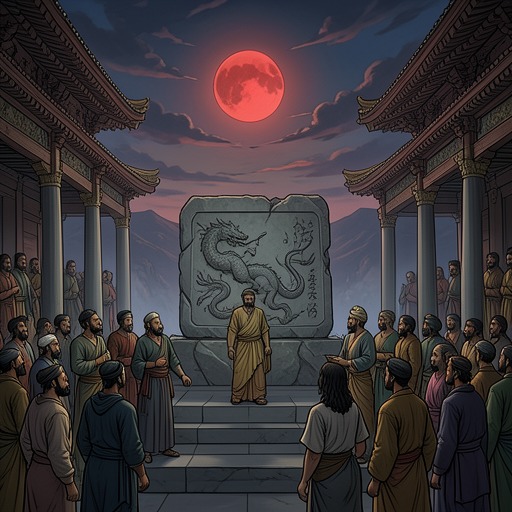
Early in AD 265, Cao Huan abdicates and Sima Yan ascends the throne. Jia Chong reads the proclamation that Heaven’s Mandate passed from Han to Wei and has now passed from Wei to the Sima family. Cao Huan is reduced to a minor title, while Sima Yan becomes emperor of the Great Jin. The proclamation frames a coercive political transfer in the formal language of the Mandate of Heaven and succession by precedent.
Reunification and Dynastic Cycle
Sima Yan’s significance extends beyond the establishment of Jin. After the kingdoms of Wei, Shu, and Wu have successively fallen, the narrative reports that the Three Kingdoms are once again made one under Jin. This reunification fulfills the book’s recurring pattern of division followed by consolidation, while the Wei’s replacement by Jin shows that unity does not end the succession of dynasties.
The account thus makes Sima Yan both the beneficiary of his family’s accumulation of power and the agent who turns that power into a new imperial order. His accession closes the Wei dynasty and establishes Jin, while the eventual reunification gives his reign a larger place in the book’s history of kingdoms rising from disorder and, in turn, giving way to new political arrangements.